
 Pablo tore
Key Takeaways
- The U.S. has several world-class oil and gas basins driving national energy production.
- The Permian Basin is the largest and most productive oil basin in America.
- Major basins include Permian, Eagle Ford, Bakken, Marcellus, Haynesville, and Anadarko.
- Nearly 50% of U.S. crude oil production now comes from the Permian Basin alone.
- Basin productivity depends on reserves, infrastructure, drilling cost, and well efficiency.
The United States remains the world’s largest oil producer in 2026, producing around 13.6–13.7 million barrels per day (bpd). A major reason behind this dominance is the country’s large and resource-rich sedimentary basins. These basins contain massive reserves of crude oil, natural gas, shale resources, and natural gas liquids (NGLs).
Oil and gas basins are underground geological formations where hydrocarbons accumulate over millions of years. Some basins are conventional, while others are shale-based and require advanced drilling methods like hydraulic fracturing and horizontal drilling.
What Is an Oil and Gas Basin?
An oil and gas basin is a large geological depression where organic material was buried, heated, and transformed into hydrocarbons.
These basins usually contain:
- Crude oil
- Natural gas
- Condensates
- Shale formations
The economic value of a basin depends on:
- Recoverable reserves
- Breakeven production cost
- Infrastructure access
- Production efficiency
Major Oil and Gas Basins in the US
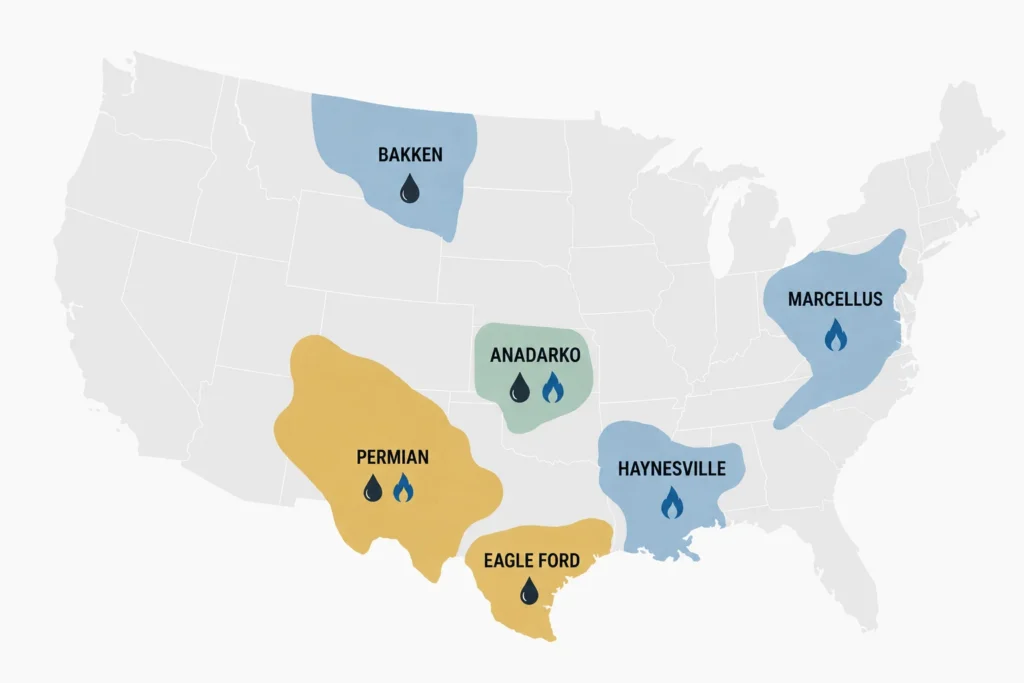
| Basin | Main Location | Primary Resource | Importance |
|---|---|---|---|
| Permian Basin | Texas / New Mexico | Oil + Gas | Largest oil basin |
| Eagle Ford | South Texas | Oil + Gas | Major shale basin |
| Bakken | North Dakota | Oil | High shale output |
| Marcellus | Pennsylvania | Natural Gas | Largest gas basin |
| Haynesville | Texas / Louisiana | Natural Gas | LNG-linked gas hub |
| Anadarko | Oklahoma | Oil + Gas | Major mixed basin |
1. Permian Basin
The Permian Basin is the most important oil-producing basin in the United States.
Located in:
- West Texas
- Southeastern New Mexico
Why it dominates:
- Huge recoverable reserves
- Low breakeven costs
- High well productivity
- Strong pipeline network
2026 production:
- ~6.5–7 million bpd oil
- ~28+ Bcf/day natural gas
That means the Permian contributes roughly half of total U.S. crude output. (U.S. Energy Information Administration)
Quick Fact
Recent USGS assessments found 1.6 billion barrels of additional technically recoverable oil in deeper Permian formations. (CPG Click Oil and Gas)
2. Eagle Ford Basin
The Eagle Ford Shale is located in South Texas and remains one of America’s most productive shale plays.
Key strengths:
- Fast drilling cycles
- Strong crude production
- Close to Gulf Coast refineries
It became a major contributor during the shale boom and still attracts strong investment.
Estimated 2026 production:
- ~1.1 million bpd oil
- Strong associated gas output
3. Bakken Basin
The Bakken Basin lies mainly in North Dakota.
Known for:
- Tight shale oil
- High initial well production
- Large unconventional reserves
The Bakken helped transform North Dakota into a top oil-producing state.
Estimated production:
- ~1.2 million bpd
Even though growth slowed, it remains a major national asset.
4. Marcellus Basin
The Marcellus Shale is America’s largest natural gas basin.
Located across:
- Pennsylvania
- West Virginia
- Ohio
Major advantage:
- Massive gas reserves
- Strong pipeline connectivity
- Low-cost gas production
Estimated gas production:
- 35+ Bcf/day
Quick Fact
Marcellus is critical for LNG exports and power generation.
5. Haynesville Basin
The Haynesville Basin spans East Texas and Louisiana.
This basin is increasingly important because of rising LNG demand.
Strengths:
- Dry gas production
- Proximity to LNG terminals
- Strong industrial demand
Haynesville has become one of America’s fastest-growing gas regions. (Financial Times)
Estimated output:
- 17–18 Bcf/day
6. Anadarko Basin
The Anadarko Basin covers much of Oklahoma.
It produces:
- Oil
- Natural gas
- NGLs
Why important:
- Long production history
- Mature infrastructure
- Balanced hydrocarbon mix
Though smaller than Permian, Anadarko remains vital for regional supply.
Which Basin Is the Largest?
By production and economic importance, the ranking is roughly:
- Permian Basin
- Marcellus Basin
- Eagle Ford
- Bakken
- Haynesville
- Anadarko
The Permian clearly leads due to scale, productivity, and reserve quality.
Future Outlook for US Basins
U.S. basins are expected to remain highly productive through 2030.
Growth drivers:
- AI-driven drilling optimization
- Better completion techniques
- Higher export demand
- New resource discoveries
Challenges include:
- Price volatility
- Regulation
- Water management
- Infrastructure bottlenecks
Final Thoughts
Major oil and gas basins are the backbone of U.S. energy production. In 2026, the Permian Basin continues dominating crude oil output, while basins like Marcellus and Haynesville power America’s natural gas growth. Together, these basins keep the U.S. at the center of global energy markets..

GIPHY App Key not set. Please check settings